

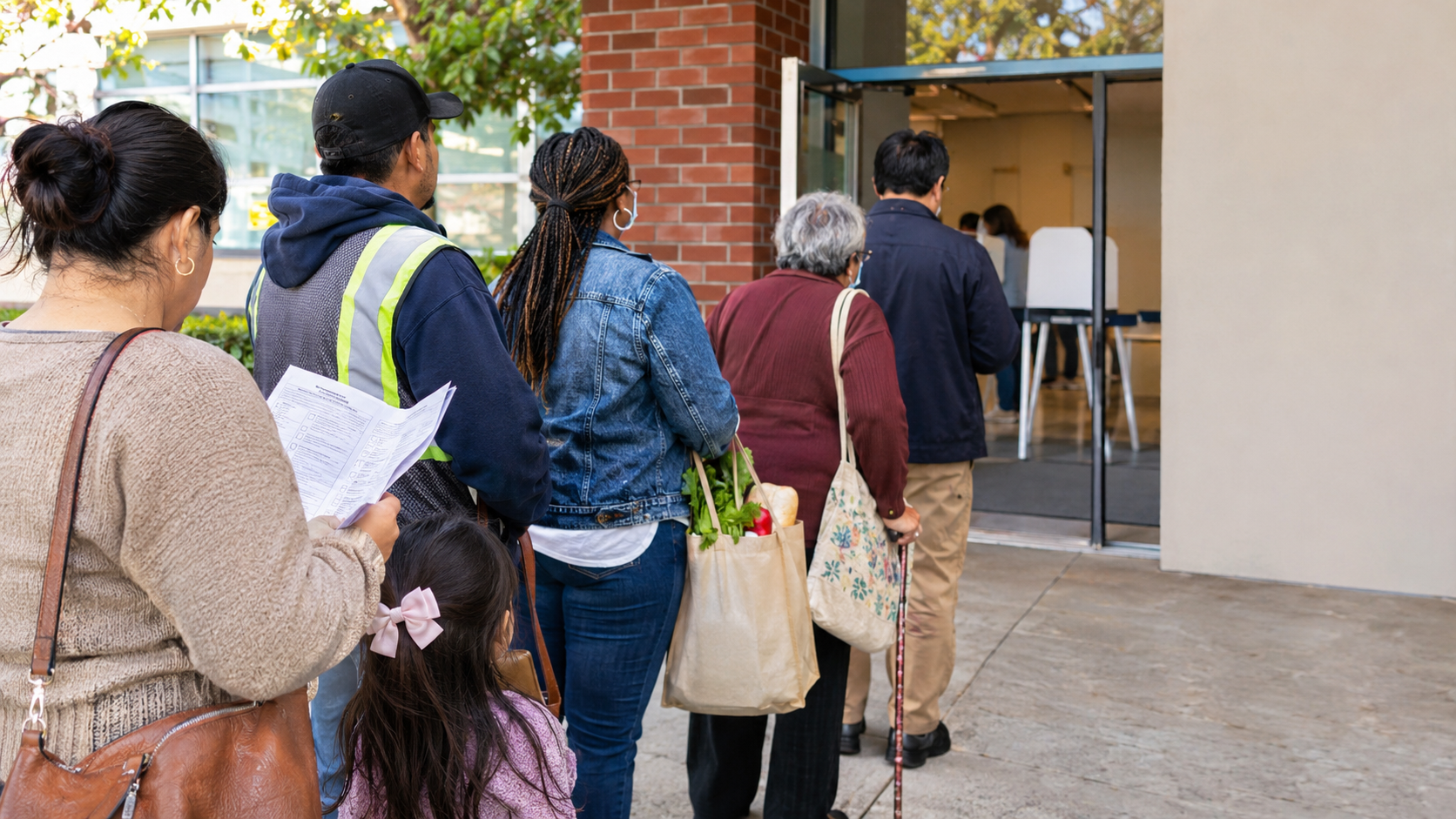
Journalists covering Asian, Latino, Black, Native American and Arab American communities report mounting concerns over affordability, immigration enforcement and civil rights as voters prepare for the November 3 elections.
With Americans preparing to vote in the November 3 midterm elections, rising living costs, immigration fears and concerns about civil rights are shaping political conversations across the nation’s ethnic communities. Yet a critical question remains unanswered: Will growing anxiety and frustration translate into higher voter turnout, or will uncertainty, fear and political disillusionment keep some eligible voters away from the polls?
That question dominated an October 30 national briefing organized by American Community Media (ACoM), where six journalists covering diverse communities described an electorate confronting similar economic pressures but responding differently to the political climate. Moderated by ACoM Associate Editor Pilar Marrero, the discussion showed that political awareness does not always lead to electoral participation, even when families believe government decisions directly affect their livelihoods.
Economic Pressures and Immigration Fears
Affordability emerged as a shared concern across communities. Néstor Fantini, co-editor of HispanicLA.com and a sociology professor at Rio Hondo College in California, said Latino voters in Los Angeles are struggling with housing costs, groceries, utilities, and immigration enforcement. Citing a recent UCLA study, he reported that 76 percent of registered Latino voters in California were deeply concerned about keeping up with living expenses.
Fantini described the community’s anxiety as extending beyond household finances to fears of immigration detention and deportation. Although those concerns have generated political interest, he cautioned that their effect on turnout remains uncertain. Some voters are fearful, while others are increasingly determined to participate.
Similar pressures are affecting Chinese American communities in New York, according to Rong Xiaoqing, a reporter for the Chinese-language Sing Tao Daily. She described stronger interest in voting than in previous midterm elections, alongside concerns about inflation and immigration enforcement. In neighborhoods such as Flushing and Sunset Park, she said, anxiety surrounding immigration policies has affected restaurants, transportation businesses, and customers’ willingness to travel.
Xiaoqing also emphasized that Chinese American voters do not share identical political views. Some support stricter immigration policies, demonstrating that the same issue can motivate voters with opposing perspectives.
For Indian Americans in Silicon Valley, economic uncertainty carries additional consequences. Vandana Kumar, publisher and CEO of India Currents, said technology layoffs and the changing employment landscape have created insecurity among professionals, particularly those holding H-1B visas.
“A job loss isn’t just a financial setback,” Kumar said, explaining that unemployment can also threaten immigration status and a family’s future in the United States.
She distinguished between following political developments and participating in elections. Some immigrants are deeply engaged in public affairs but cannot vote, while eligible voters may question whether their participation will make a difference.
Voting Rights, Representation and Community Concerns
In Mississippi, Dr. Edelia J. Carthan, a contributing writer for The Mississippi Link, described growing political interest among Black voters concerned about healthcare access, rising prices, voting rights, and the rollback of diversity, equity, and inclusion initiatives.
Carthan pointed to Democratic Senate candidate Scott Colom’s campaign against Republican incumbent Cindy Hyde-Smith as an important, attention-grabbing contest. She connected current political debates with Mississippi’s history of racial discrimination and voter suppression, emphasizing the importance of understanding that history when evaluating contemporary policies and elections.
For Native American communities, the election also concerns longstanding treaty obligations and tribal sovereignty. Lori Ann Edmo, editor of Sho-Ban News in Idaho, said federal funding decisions directly affect programs serving tribal members.
Edmo highlighted concerns about public lands, natural resources, and protecting treaty rights, particularly access to land traditionally used for hunting and fishing. She said these issues have encouraged political participation and stressed that candidates must understand tribal communities’ distinct legal relationship with the federal government.
In Michigan, Osama Siblani, publisher of The Arab American News, described heightened anxiety among Arab and Muslim Americans over discrimination, hostile political rhetoric, and their place in American society. Siblani said he had personally faced accusations and threats that he disputed, while also observing strong political engagement within his community.
He identified healthcare affordability, food prices, and constitutional protections as major concerns, arguing that voters should evaluate candidates on principles and policies rather than ethnicity or religion.
The Critical Role of Community Journalism
Beyond the competing political concerns, the journalists identified a common responsibility for ethnic media: helping readers understand how government decisions affect their daily lives.
Kumar emphasized that community journalists can explain complicated policies while respecting their audiences’ independence. Xiaoqing described the importance of providing practical information about voter registration, polling locations, and election deadlines. Edmo stressed reporting on treaty rights and natural resources, while Carthan highlighted historical context and sustained coverage of local government.
Their observations carry relevance for diverse metropolitan communities in Houston and Dallas-Fort Worth, where immigrant families, small-business owners and working households also confront questions about affordability, representation and government policy.
As Election Day approaches, the central uncertainty is not whether voters are concerned. The journalists presented abundant evidence of concern. What remains to be seen is whether those feelings produce greater participation, particularly among younger voters and communities facing barriers to engagement. The November 3 results will provide an important measure of whether political anxiety has translated into electoral action.