

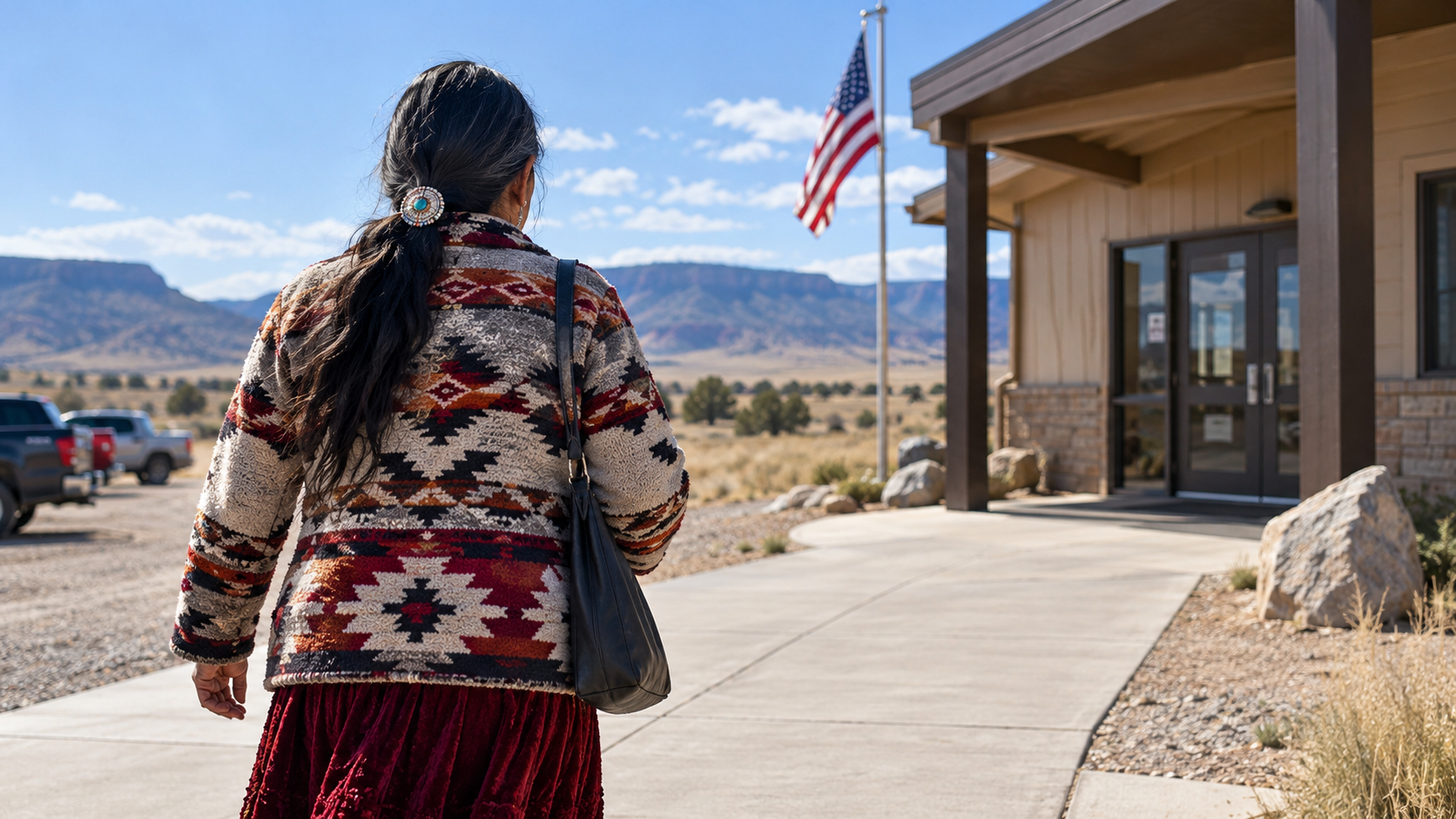
As Americans prepare for the November 2026 midterm elections, Native American voters are confronting a political contradiction: Their ballots could influence closely contested races, yet many continue to face obstacles that make voting more difficult than it is for other Americans. From distant polling places and restrictive identification requirements to longstanding struggles over tribal sovereignty, Indigenous communities are demanding greater recognition and a meaningful role in decisions affecting their future. These concerns dominated an October 9 national news briefing organized by American Community Media (ACOM), where researchers, tribal advocates, and youth organizers examined the growing political significance of the Native vote and the persistent inequalities surrounding it.
Political Influence and Representation
Michael Roberts, president and CEO of First Nations Development Institute and a member of the Tlingit Tribe, challenged the tendency to treat Native Americans as a politically uniform population. He explained that Indigenous voters share widespread national concerns about inflation, housing affordability, employment, and economic opportunity, while also placing particular importance on tribal sovereignty, ancestral lands, cultural preservation, and Native languages. According to research Roberts presented, 82 percent of surveyed rural and reservation respondents considered issues involving land, sovereignty, and culture highly important, compared with 72 percent of urban Native respondents. He argued that the findings show geographic differences do not necessarily diminish shared political priorities.
Roberts also questioned the reliability of some national political polling concerning Native Americans. He said research supported by his organization indicated that approximately 57 percent of surveyed Native voters supported Kamala Harris in the 2024 presidential election, contrasting with an earlier widely circulated figure suggesting stronger support for Donald Trump. He cautioned against drawing sweeping conclusions from limited samples and maintained that Native political preferences deserve more accurate representation. Equally troubling, he said, was evidence from his organization’s research suggesting that roughly half of Native voters had not been contacted by political campaigns before the previous election. Such limited outreach could prove consequential in competitive states, including Alaska and Michigan.
The High Cost of Voting
For many Native Americans, voting involves obstacles that go far beyond political preference. Melissa Rogers, a political science professor at Claremont Graduate University and co-director of its Inequality and Policy Research Center, described what researchers call the cost of voting:: the practical burden of registering, reaching polling places, obtaining acceptable identification, and ensuring ballots are counted.
Rogers cited the Duck Valley Reservation in Nevada, where residents historically traveled about 100 miles to reach designated voting facilities. Similar difficulties arise when reservation households lack conventional street addresses or convenient postal services, complicating voter identification and mail-in voting. She explained that reducing geographic barriers by establishing accessible registration services and polling places on tribal lands can increase participation while strengthening confidence in elections. Urban Indigenous voters face different challenges, including long lines, limited voting locations, and transportation problems. Her central argument was that election participation depends not only on whether citizens have voting rights, but also on whether they can realistically exercise them.
Sovereignty and a New Generation
Judith LeBlanc, executive director of the Native Organizers Alliance and a Caddo Nation citizen, emphasized that Native political participation cannot be separated from tribal sovereignty. Unlike ordinary interest groups, federally recognized tribes possess a distinct political and legal relationship with the United States. LeBlanc explained that treaty obligations, land rights, public services and political representation remain central concerns for Indigenous communities. Her organization has supported grassroots engagement across tribal and urban communities, where organizers report growing concern about public funding, essential services, and the protection of democratic rights.
LeBlanc also described organizing involving the Miccosukee Tribe in Florida, where Indigenous sovereignty, environmental protection and immigrant rights intersected in opposition to a detention facility in the Everglades. The example illustrated how Native political advocacy can extend beyond tribal communities and involve broader coalitions. She also highlighted growing interest among Indigenous candidates seeking public office, arguing that representation gives communities more opportunities to influence decisions rather than respond to them.
That emerging political leadership is particularly evident among younger Native Americans. Sage Phillips, a Penobscot Nation citizen, Wabanaki Alliance community engagement coordinator, and co-coordinator of the Wabanaki Policy Youth Initiative, described how young people in Maine are learning to organize, engage lawmakers, and register voters. The initiative has involved approximately 20 Indigenous and non-Indigenous young people advocating on issues including the 1980 Maine Indian Land Claims Settlement Act and stronger implementation of Indigenous education requirements in public schools.
Phillips said participants are educating elders, meeting candidates and demanding accountability for longstanding commitments to tribal communities. She suggested their activism reflects a determination to shape government policy rather than wait for political leaders to act on their behalf.
For Native Americans, the approaching election therefore represents more than a contest between political parties. It will test whether candidates recognize tribal sovereignty, whether election officials make voting genuinely accessible, and whether Indigenous communities gain representation proportionate to their political aspirations. For readers in Texas and across the country, the larger democratic question is equally significant: whether every eligible citizen can participate meaningfully in determining the policies and leadership that shape American life.