

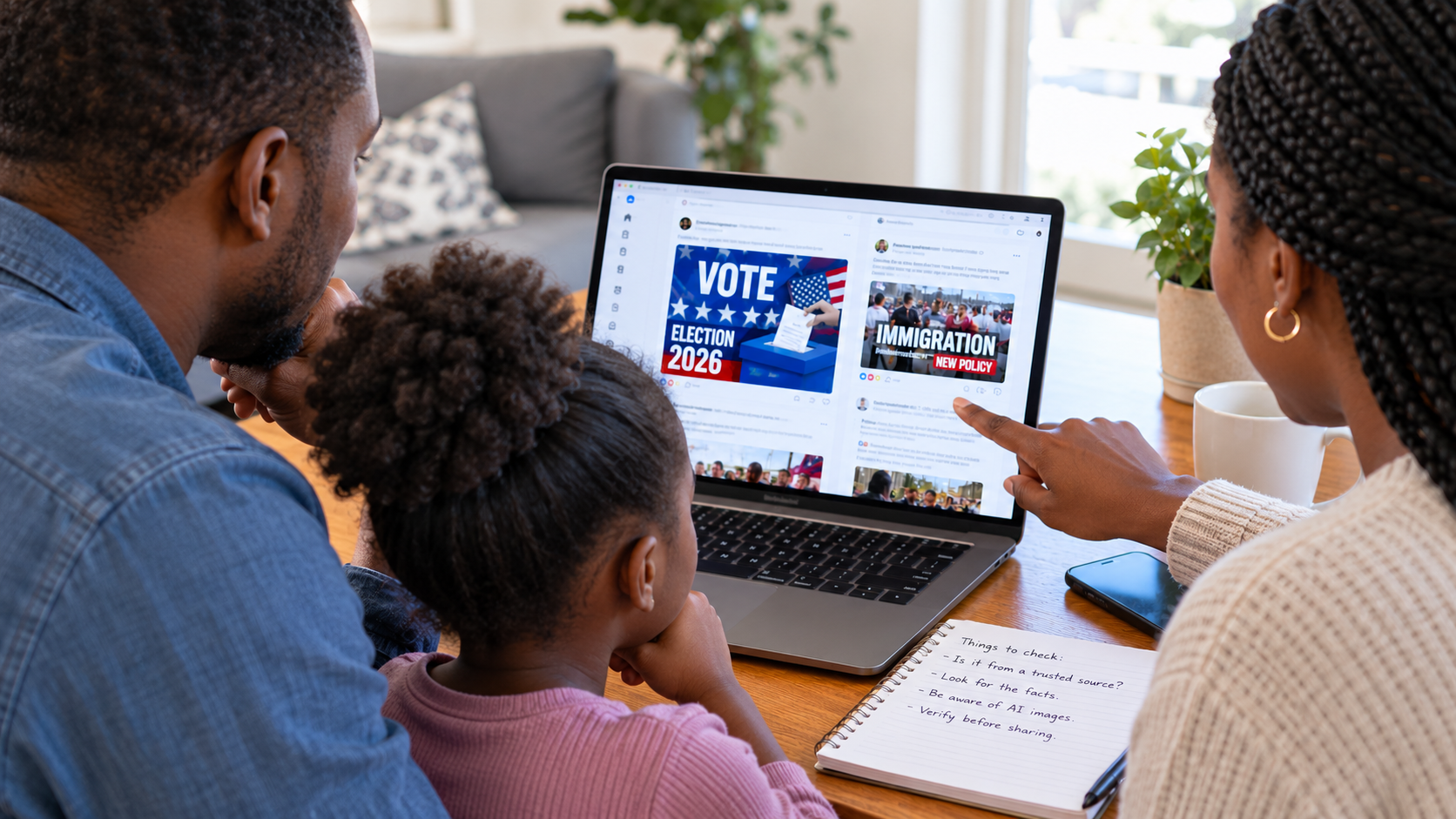
As the November midterm elections approach, experts warn that misleading immigration narratives, AI-generated political content, and unreliable chatbot answers are threatening voter confidence, particularly in immigrant and non-English-speaking communities.
False images of immigration agents intimidating voters, misleading claims about noncitizen voting, and artificial intelligence systems providing inaccurate election information are creating new challenges for immigrant communities preparing to participate in the November 3 midterm elections. Election misinformation is no longer confined to deceptive social media posts. It is increasingly entering private messaging groups, trusted community networks, and AI-powered information services, raising concerns that eligible voters could become too frightened or confused to exercise their constitutional rights.
These concerns dominated an October 23 national news briefing organized by American Community Media (ACoM), titled “Who Gets the Last Word? Election Disinformation in Immigrant Communities.” Three specialists examined how misleading information travels across languages and digital platforms, warning that technological advances are making false narratives easier to manufacture, distribute, and believe.
When Fear Becomes a Weapon Against Voting
Cameron Hickey, CEO of the National Conference on Citizenship, described election misinformation as a threat extending beyond the accuracy of individual political claims. He distinguished misinformation, which can spread without malicious intent, from disinformation deliberately created to deceive. He explained that both can undermine public confidence and discourage civic participation.
“This is a civic health problem,” Hickey said, emphasizing that widespread distrust can weaken confidence in elections, government institutions and communities themselves.
Among his concerns are fabricated images depicting Immigration and Customs Enforcement agents intimidating voters at polling locations. Hickey said documented examples of AI-generated imagery have circulated online, while reports of actual immigration enforcement activity have compounded fears among newly naturalized citizens.
He also questioned claims about noncitizen voting and the federal government’s use of citizenship verification systems, arguing that outdated information can confuse people about the eligibility of naturalized Americans.
For immigrant families, the consequences can extend beyond political disagreements. Someone who has legally obtained citizenship may still hesitate to go to a polling location after repeatedly encountering frightening or misleading immigration-related messages.
False Narratives Cross Language Barriers
Jinxia Niu, program manager of Chinese Digital Engagement at Chinese for Affirmative Action, presented research showing how election disinformation moves between English-language political networks and Chinese-speaking communities.
Her organization, which operates the Chinese-language fact-checking platform PiYaoBa, has tracked more than 600 pieces of disinformation. Niu said X, formerly Twitter, has become an increasingly important source of Chinese-language election narratives, many of which subsequently circulate through WeChat and other platforms.
She identified three recurring themes: allegations of election fraud, misleading claims about noncitizen voting, and partisan attacks built around distorted political narratives.
According to Niu, these messages frequently exploit differences between American voting procedures and those familiar to immigrants from other countries. For example, confusion over voter identification requirements can make misleading allegations seem credible.
She also outlined findings from Divided by Design, a report examining anti-immigrant narratives affecting Chinese, Indian, Filipino and Vietnamese communities. The research identifies fear, internal divisions and limited access to reliable information as persistent challenges.
Niu said her team had identified more than 150 social media accounts spreading disinformation. She also raised concerns that Chinese-language AI search responses can disproportionately surface particular political media outlets rather than independent fact-checking resources.
Artificial Intelligence Creates New Election Risks
Laura Zommer, co-founder and CEO of Factchequeado, a nonprofit organization combating Spanish-language misinformation, warned that AI-generated political videos are becoming increasingly difficult for ordinary voters to recognize.
Citing Wesleyan Media Project research available in early September, Zommer said researchers identified at least 169 political advertisements using artificial intelligence, representing about $80 million in advertising spending. She said 69 percent of those advertisements failed to disclose that AI was used.
Her concerns extend to the growing reliance on chatbots for basic election information.
Zommer cited research by the Institute for Strategic Dialogue showing that approximately 30 percent of English-language chatbot answers tested were incorrect, incomplete, or outdated, compared with 45 percent of Spanish-language responses. In one example, she said a chatbot incorrectly identified November 4 as Election Day instead of November 3.
Factchequeado is also examining chatbot responses to election questions specifically involving Texas, including whether different political framing produces different answers.
For Houston and Dallas-Fort Worth’s multilingual communities, the findings underscore the importance of obtaining election information from verified sources rather than relying exclusively on forwarded messages, online influencers, or automated answers.
Hickey recommended the SIFT verification method: Stop before sharing, Investigate the source, Find better coverage, and Trace claims to their original context.
Zommer emphasized that fact-checking can influence behavior even when it does not immediately change deeply held beliefs. Niu similarly warned that education alone does not guarantee immunity from disinformation, noting that highly educated first-generation immigrants can also struggle to recognize manipulation.
With Election Day approaching, the central challenge is ensuring that reliable information reaches voters before misleading narratives shape their decisions. Election officials, journalists and community organizations face a growing responsibility to explain voting procedures accurately, address legitimate concerns and distinguish documented problems from manufactured claims. The stakes extend beyond November 3: public confidence in election results may depend increasingly on whether voters can distinguish credible evidence from convincing digital falsehoods.