

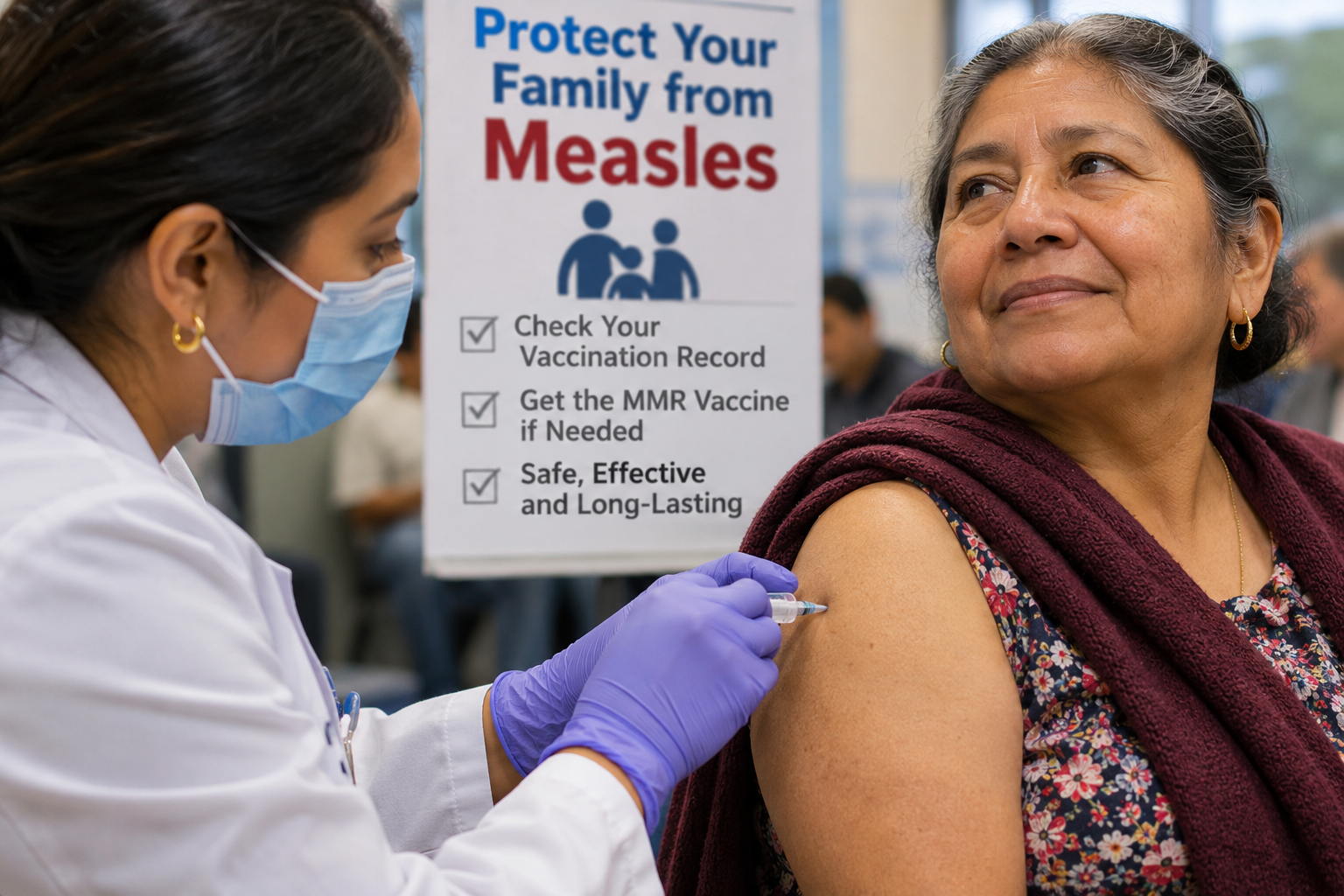
Health experts warn that declining vaccination rates, missing immunization records, and barriers to healthcare are leaving some adults vulnerable to a disease once considered largely under control.
By The Christian Herald | American Community Media Briefing, November 13, 2026
The resurgence of measles across the United States is raising serious concerns among public health experts, particularly for older immigrants who may have missed childhood vaccinations in their countries of origin. With more than 5,400 cases reported across 45 states in 2026, medical professionals warn that declining vaccination rates are threatening decades of progress against one of the world’s most contagious diseases. During a November 13 national news briefing organized by American Community Media (ACoM), four healthcare experts examined the growing outbreak, its consequences for adults and the urgent need to strengthen vaccination awareness among immigrant communities. The discussion, moderated by ACoM Health Editor Sunita Sohrabji, came as the Pan American Health Organization reviewed whether the United States should retain the measles elimination status it achieved in 2000.
A Public Health Achievement Under Threat
Patsy Stinchfield, executive director of the Measles Collaborative, described the situation as a national public health emergency. According to figures presented during the briefing, approximately 41 percent of reported measles cases involved adults aged 20 and older, a significant departure from the traditional perception of measles as primarily a childhood illness. Stinchfield warned that falling vaccination rates have created conditions for renewed transmission, explaining that public health experts generally consider vaccination coverage of approximately 95 percent necessary to prevent sustained community outbreaks. “This outbreak is out of control,” Stinchfield said, pointing to rapidly increasing cases in several states. She emphasized that losing elimination status would be a significant setback for American public health, even without direct legal or financial penalties. The rising number of cases shows how quickly measles can return when community vaccination levels decline, particularly in areas where large numbers of people remain unprotected.
Why Older Immigrants Face Particular Risks
Dr. Andi Shane, professor and chief of pediatric infectious diseases at Emory University School of Medicine, explained that older immigrants may face distinctive vulnerabilities because childhood vaccination programs developed at different times around the world. Many African, Asian, and Latin American countries introduced routine measles immunization later than the United States. Consequently, some adults may have reached adulthood without receiving the vaccine or contracting the disease. Shane also identified missing vaccination records, language barriers, and limited access to healthcare as obstacles to establishing immunity. Although measles produces similar symptoms in children and adults, including fever, cough, red eyes, and a distinctive rash, adults face increased risks of pneumonia, hospitalization, and other complications. Pregnant women and individuals with underlying medical conditions require particular attention. Shane emphasized that measles affects every age group and explained that adults may experience more serious complications during the infection itself, making prevention particularly important for individuals uncertain about their immunity.
How Adults Can Protect Themselves
Dr. Margot Savoy, chief medical officer of the American Academy of Family Physicians, urged adults uncertain about their vaccination history to consult healthcare professionals about receiving the measles, mumps, and rubella (MMR) vaccine. Under the guidance discussed at the briefing, most adults born in 1957 or later without evidence of immunity need one dose, while healthcare workers, international travelers, college students and certain other higher-risk individuals may require two. Savoy explained that one dose provides approximately 93 percent protection, increasing to 97 percent with two doses. Protection is generally long-lasting, and routine boosters are unnecessary for fully vaccinated adults. She also addressed concerns about missing records, noting that vaccination documentation from another country can establish immunity. Blood testing is available when appropriate, although vaccination is often the simpler option for eligible adults without documentation. For older immigrants who may have difficulty obtaining medical records from their countries of origin, consulting a healthcare professional offers a practical way to establish protection.
Building Trust Within Immigrant Communities
For Munira Maalimisaq, founder and CEO of Inspire Change Clinic in Minneapolis, measles prevention carries deeply personal significance. She revealed that her sister died from measles in Somalia before their family immigrated to the United States. “I cannot change what happened to my sister, but what I can change is what happens to other families,” she told participants. Maalimisaq described troubling declines in childhood vaccination rates within Minnesota’s Somali American community and highlighted the success of her Motherhood Circle initiative, which gives mothers a space to discuss health concerns without judgment. Among 75 mothers participating in the program in 2025, the proportion reporting MMR vaccination for their children increased from 12 percent to 89 percent by graduation. Her experience demonstrates that culturally sensitive communication, affordable healthcare, and trusted community relationships can significantly improve vaccination confidence. Experts also cautioned against blaming immigrants for measles outbreaks, noting that available national research shows comparable immunity levels among U.S.-born and foreign-born populations.
For immigrant families, churches and community organizations, the briefing underscored an important responsibility: encouraging accurate health information, reviewing vaccination histories and connecting vulnerable residents with healthcare services. Religious and community leaders, particularly those serving immigrant populations, can play a valuable role by helping families overcome misinformation, language barriers, and uncertainty about accessing healthcare. As measles continues to spread across the country, experts emphasized that prevention will depend not only on medical intervention but also on informed communities willing to protect themselves and one another. Their central message was clear: measles is preventable, effective vaccines are available, and no family should have to suffer the consequences of a disease against which modern medicine provides such strong protection.