

Hate Crimes Continue Despite Federal Action
Five years after the COVID-19 Hate Crimes Act was signed into law, advocates and civil rights leaders say hate crimes and hate incidents targeting minority communities remain alarmingly high, fueled by political rhetoric, underreporting, and growing fear among immigrant populations. During a national briefing hosted by American Community Media in partnership with Asian Americans Advancing Justice-AAJC, speakers warned that many communities are experiencing renewed hostility and increasing isolation despite federal legislation intended to improve hate crime reporting and prevention.
The briefing brought together experts from Asian Americans Advancing Justice-AAJC, Stop AAPI Hate, the Muslim Public Affairs Council, and the Sikh Coalition to discuss the continuing rise in anti-Asian hate, anti-Muslim discrimination, anti-Sikh violence, and broader attacks on immigrant communities.
Sunita Sohrabji, health editor at American Community Media and moderator of the briefing, noted that anti-Asian hate crimes and incidents remain nearly three times higher than pre-pandemic levels. She cited FBI statistics showing hundreds of reported hate crimes targeting Asian Americans, Sikhs, Muslims, Hindus, Buddhists, and Native Hawaiian and Pacific Islander communities, while also emphasizing that the data likely represents a severe undercount because many incidents go unreported.
John C. Yang, president and executive director of Asian Americans Advancing Justice-AAJC, warned that inflammatory political rhetoric is contributing to a dangerous climate. Referring to recent comments aimed at immigrants from China and India, Yang said, “When we have a federal government that is not only failing to prevent hate incidents but actively engaging in conduct and speech that incentivizes it, all Americans suffer.”
Yang argued that hate targeting Asian Americans has historical roots dating back to the Chinese Exclusion Act, the incarceration of Japanese Americans during World War II, and the targeting of Muslim and South Asian communities after 9/11. He said the stereotype that Asian Americans are perpetual foreigners continues to resurface in times of political tension and economic anxiety. “We have seen these playbooks before,” Yang said. “Our communities have responded to these playbooks before and we just need to rise up and do that again.”
Communities Living in Fear
Mannirmal Kaur, senior federal policy manager for the Sikh Coalition, explained that anti-Sikh violence in America stretches back more than a century. She recalled the killing of Balbir Singh Sodhi shortly after the September 11 terrorist attacks and noted that Sikh Americans continue to face bullying, harassment, and violence because of ignorance and religious bias.
Kaur said recent political rhetoric surrounding immigration and diversity has worsened the environment for many minority communities. “Racism, bigotry, and xenophobia have featured prominently in mainstream politics and culture in recent years in new and alarming ways,” she said.
Sameer Hossain of the Muslim Public Affairs Council shared deeply personal examples of anti-Muslim violence, including attacks that followed the September 11 attacks and the Israel-Hamas war. He described how Muslim Americans increasingly fear harassment, surveillance, and exclusion from public life. Hossain revealed that his organization has documented an eleven-fold increase in attacks against American Muslims and mosques in recent months.
“One of the most dangerous consequences is the chilling effect,” Hossain said. “People are stepping back from political and social life because they are afraid.”
Stephanie Chan, director of data and research at Stop AAPI Hate, presented newly released findings showing that half of AAPI adults surveyed in 2025 reported experiencing some form of hate based on race, ethnicity, or nationality. The organization tracks not only criminal hate crimes but also non-criminal hate incidents such as harassment, threats, and discrimination.
Chan said much of the rhetoric directed at immigrants has evolved from pandemic-related blame to direct threats tied to immigration enforcement. She described reports in which individuals were told, “Trump should deport you,” or threatened with being reported to immigration authorities even when they were American citizens.
Major Conclusions From the Briefing
Several key conclusions emerged from the discussion.
First, hate crimes and hate incidents remain significantly underreported because many victims do not trust law enforcement or fear immigration consequences. Speakers repeatedly stressed that immigrants often hesitate to contact authorities because they fear detention, deportation, or surveillance.
Second, speakers agreed that political rhetoric matters. Multiple panelists argued that inflammatory language from public officials and online influencers can embolden people to commit acts of harassment and violence against minority groups.
Third, experts emphasized that hate is not limited to violent crimes. Much of the damage comes through bullying, workplace discrimination, public harassment, online abuse, and intimidation that isolates people from civic life.
Fourth, panelists concluded that education and community engagement are critical to prevention. Kaur highlighted studies showing that students are less likely to bully Sikh classmates when schools include Sikh history and culture in social studies curricula.
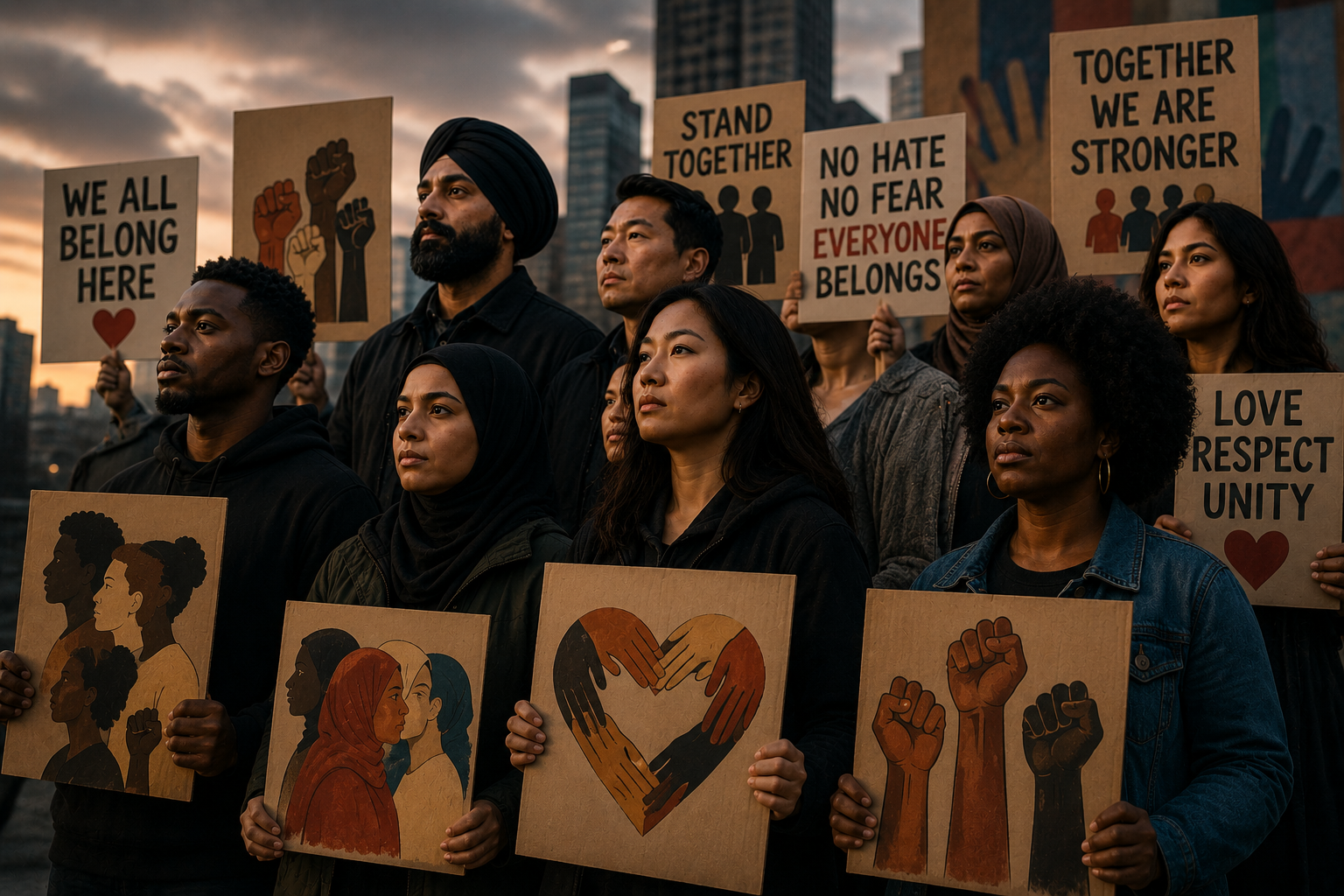
Finally, speakers stressed the importance of solidarity across communities. Black, Asian, Muslim, Sikh, Latino, Jewish, and immigrant communities are all being affected by rising polarization and discrimination. Panelists repeatedly encouraged communities not to withdraw in fear but to remain engaged, report incidents, support victims, and build coalitions that protect civil rights for all Americans.