
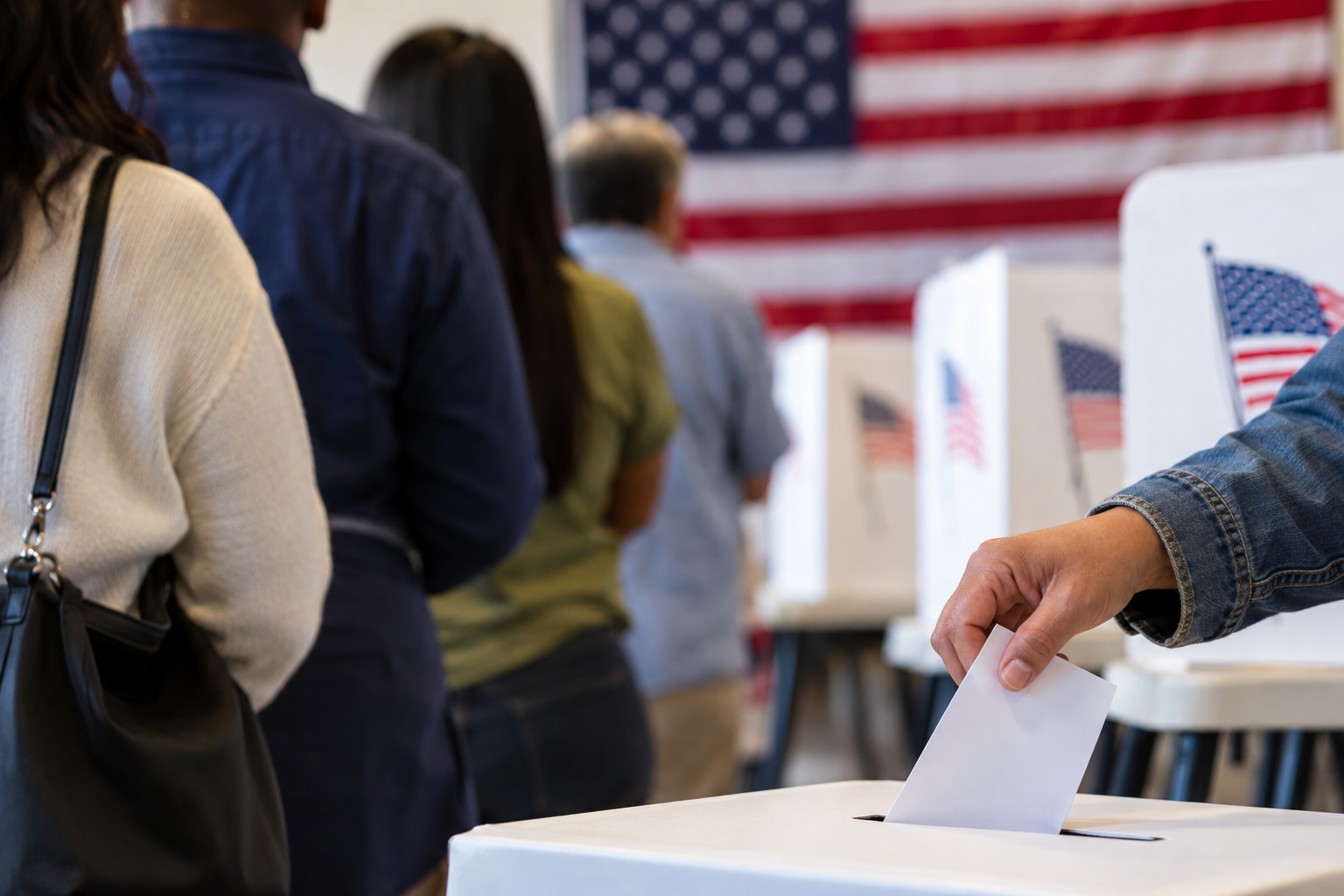
As Americans prepare for the November 2026 midterm elections, voting rights advocates are warning that many voters, particularly those in Black, Latino, Asian American, Native American, immigrant and rural communities, may encounter significant obstacles before they ever reach the ballot box. During a recent American Community Media, ACOM, national news briefing titled “Barriers to Voting in the Midterms: Impact on Ethnic Voters,” four voting rights and community leaders discussed voter identification requirements, language access, redistricting, fear surrounding immigration enforcement, and the practical difficulties that can discourage eligible citizens from participating in elections. The speakers were John C. Yang, president and executive director of Asian Americans Advancing Justice | AAJC; Jacqueline De León, senior staff attorney with the Native American Rights Fund; Rev. Dr. Monica Spencer, Georgia state director for VoteRiders; and Jesus Zamora, field director for Mi Familia Vota. Invite 9-25-26 Barriers to Voti…
Voting Rights Under Pressure
John C. Yang said one of the most important challenges facing Asian American voters is ensuring that eligible citizens understand both their rights and the rules governing the election process. Yang, whose organization works on civil rights, public policy, education and litigation affecting Asian American and Pacific Islander communities, stressed that barriers do not always come in the form of an outright prohibition on voting. They can also include confusing requirements, inadequate language assistance, misinformation and changes in election procedures that make participation more difficult. His broader message was that communities must be informed before Election Day and should not allow uncertainty or intimidation to keep eligible voters away from the polls. Yang’s organization has long worked on policies affecting Asian American and other minority communities. Speaker Bios 9_25_26 Barriers t…
Language access is particularly important in diverse metropolitan areas such as Houston and Dallas-Fort Worth, where many citizens live in households in which English is not the primary language. The briefing emphasized that being eligible to vote does not necessarily mean that navigating registration forms, election notices, identification requirements or polling-place procedures will be easy. For ethnic media organizations, churches and community groups, this creates an important responsibility to distribute accurate information in ways that people can understand and trust.
Native Voters Face Unique Obstacles
Jacqueline De León focused attention on barriers affecting Native American voters, particularly those living in rural and reservation communities. De León, an enrolled member of the Isleta Pueblo and an attorney with the Native American Rights Fund, has participated in field hearings across Indian Country examining obstacles to political participation. Speaker Bios 9_25_26 Barriers t… She explained that Native voters can face challenges that are very different from those confronting voters in urban areas, including long distances to polling locations, difficulties obtaining acceptable identification and inconsistent access to election services.
Her comments underscored how seemingly ordinary election rules can have disproportionate consequences. A requirement that may appear simple on paper can become a significant burden when a voter lives many miles from a government office, lacks reliable transportation or uses an address system different from the conventional street addresses expected on some forms. De León emphasized that protecting voting rights therefore requires understanding how election rules operate in real communities, not simply how they are written.
Voter Identification Can Become a Barrier
Rev. Dr. Monica Spencer of VoteRiders concentrated on voter identification, an issue that has become increasingly important as states adopt or enforce different forms of voter ID requirements. Spencer said many eligible voters do not realize there may be a problem with their identification until they are preparing to vote. The challenge can involve an expired document, a difference between the name on an ID and the voter registration record, or the absence of one of the specific forms of identification accepted by a state.
Spencer’s work combines voting access with years of ministry and community engagement. She has served in the African Methodist Episcopal Church for more than two decades and has worked with faith communities on racial justice, health disparities, homelessness and other social concerns. Speaker Bios 9_25_26 Barriers t… During the briefing, she emphasized the importance of addressing identification problems early rather than waiting until Election Day. For churches and community organizations, that means voter education can include helping people check registration information, understand state requirements and identify reliable assistance when documentation is needed.
Latino Communities Confront Fear and Misinformation
Jesus Zamora of Mi Familia Vota discussed challenges affecting Latino voters, including misinformation, limited outreach and anxiety related to immigration enforcement. For families that include both citizens and noncitizens, political rhetoric surrounding immigration can create fear even when the person preparing to vote is legally entitled to do so. Zamora stressed the importance of direct community engagement and trusted messengers who can reassure eligible voters about their rights while providing accurate election information.
Zamora brings a particularly local perspective for Houston-area readers. Before joining Mi Familia Vota and Mi Familia en Acción, he served as secretary of the Alief Super Neighborhood, sought a position on the Alief Independent School District Board of Trustees, ran for Houston City Council District F and spent years organizing in the Houston community. Speaker Bios 9_25_26 Barriers t… His remarks reflected the importance of meeting voters where they are, including neighborhoods, churches, community centers and cultural organizations, rather than assuming that traditional political outreach will reach everyone.
Trusted Information Matters
The central message from the ACOM briefing was that voter participation cannot be taken for granted. The organization noted that voter participation among Black, Asian and Latino Americans increased significantly during the 2024 presidential election, but the question now is whether those gains can be sustained during the 2026 midterms as communities encounter new or continuing barriers. Invite 9-25-26 Barriers to Voti…
For Houston, Dallas-Fort Worth and other increasingly diverse communities, the discussion carries particular significance. Eligible citizens should confirm their registration, understand identification requirements, know where and when they can vote and rely on trusted sources rather than rumors circulating through social media. Churches, ethnic media and community organizations can also play an important nonpartisan role by providing reliable information and encouraging citizens to participate. The right to vote may be established in law, but as the speakers made clear, meaningful access to that right often depends on whether communities have the information, resources and confidence needed to exercise it.