

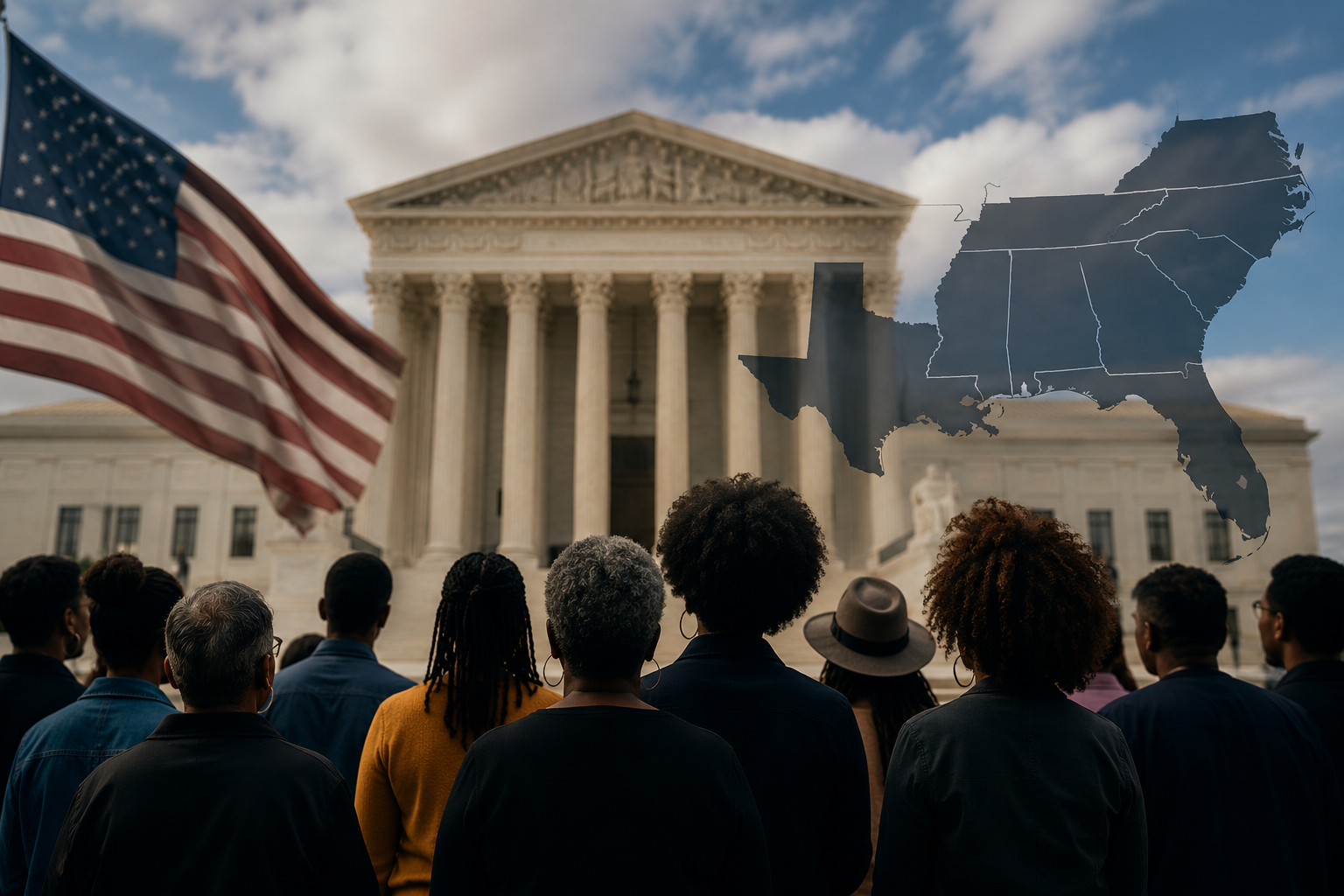
Supreme Court Decision Sparks Alarm
A growing battle over voting rights is unfolding across the Deep South following a controversial U.S. Supreme Court decision that activists say threatens decades of progress in Black political representation. Civil rights leaders, attorneys, and elected officials gathered during a national media briefing hosted by American Community Media to warn that states across the South are already moving quickly to redraw political maps in ways they say could weaken Black voting power.
The discussion centered on the Supreme Court’s recent ruling in the Louisiana v. Callais case, which voting rights advocates argue significantly weakens Section 2 of the Voting Rights Act. Section 2 has long served as one of the nation’s most important legal protections against racial vote dilution and discriminatory district maps. Mitchell Brown, Senior Counsel with the Southern Coalition for Social Justice, described the ruling as part of a larger historical pattern. “When there are periods of increased voter participation and increased opportunity for voters of color, there’s this white retrenchment that seeks to take it away,” Brown said.
Brown explained that the ruling makes it far more difficult to challenge racially discriminatory voting maps because plaintiffs may now have to prove intentional discrimination instead of simply showing discriminatory effects. “You have to have smoking gun evidence,” he said. “These legislators and legislative bodies are very cunning people, and they’re not going to say the quiet part out loud.” Brown warned that the ruling could open the door for aggressive partisan redistricting efforts throughout the South, particularly in states already moving quickly to redraw congressional districts. He pointed to Tennessee, where lawmakers recently eliminated the state’s only majority-Black congressional district in Memphis.
A Broader Historical Pattern
Amir Badat, voting rights attorney with Fair Fight Action, placed the ruling within a broader historical context tied to the struggle for Black political power in America. He explained that advances in Black representation throughout history have often been followed by legal and political backlash designed to weaken that progress. “This attack on voting rights didn’t start with Louisiana versus Callais,” Badat said, referencing previous Supreme Court decisions that weakened the Voting Rights Act, including Shelby County v. Holder in 2013.
Badat warned that the consequences could reach far beyond congressional politics and affect school boards, city councils, county commissions, and local government bodies that make decisions directly impacting education, public safety, healthcare, and economic opportunity. “These are not just abstract numbers,” Badat said. “These have real political consequences and policy consequences on people’s day-to-day lives.”
Badat noted that advocates have identified dozens of congressional and state legislative districts across Southern states that could now face redistricting challenges without the protections previously offered under Section 2. He warned that the weakening of these protections could lead to the dismantling of Black-majority districts across multiple levels of government.
Louisiana Faces Political Turmoil
Louisiana Public Service Commissioner Devante Lewis described what he called unprecedented political chaos unfolding in Louisiana following the ruling. Lewis explained that after the Supreme Court decision, Governor Jeff Landry suspended congressional elections that had already begun, despite tens of thousands of ballots already being cast. “Forty-two thousand Louisianians had already cast their ballots via mail and absentee,” Lewis said. “The governor said those votes will not count.”
Lewis accused lawmakers of rapidly advancing a new congressional map that would reduce Black representation from two congressional districts down to one while also removing racial demographic data from official redistricting documents.
Lewis also described broader efforts targeting Black political leadership in Louisiana, including the elimination of elected positions and judgeships held by Black officials. “One man has taken an onslaught on Black political power here in Louisiana,” Lewis said while discussing legislation introduced by State Senator Jay Morris. According to Lewis, voters throughout Louisiana are increasingly confused as election rules, district boundaries, and voting procedures continue changing during active election periods. “It is mass confusion and chaos down here,” he said.
Alabama Organizers Warn of a “Second Reconstruction Era”
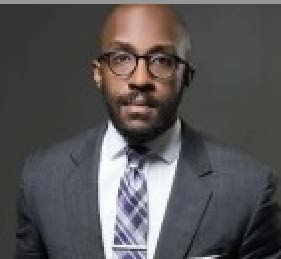
Jerome Dees of the Southern Poverty Law Center warned that Alabama could become a testing ground for the rollback of Black representation similar to what occurred after Reconstruction in the late 1800s. “We are presently in a moment of a second post-Reconstruction era,” Dees said. He emphasized the importance of continued voter participation despite the confusion surrounding court decisions and election schedules. “People need to show up and turn out at the polls,” Dees urged.
Rianne Wagner of Alabama Values argued that modern voting restrictions often use race-neutral language while still producing discriminatory outcomes. “This is bigger than lines on a map,” Wagner said. “This is about power. This is about representation.” Wagner connected current legal battles to historic efforts such as poll taxes, literacy tests, and white primaries that were historically used to suppress Black political participation. “The goal remains to limit the political power and representation of Black communities,” she said.
Communities Mobilize Instead of Retreating
Despite growing concerns, speakers repeatedly emphasized that communities across the South are responding with renewed activism and organizing efforts. Badat described large-scale mobilizations, packed public hearings, and grassroots organizing campaigns taking place throughout Louisiana, Alabama, Mississippi, and other Southern states.
Lewis pointed to increased Black voter turnout in Louisiana as evidence that many voters are refusing to disengage despite efforts to dilute representation. “You may have tried to take my representation away, but my vote is still here,” Lewis said.
Throughout the briefing, panelists stressed that the issue extends beyond Black communities alone. Speakers encouraged Latino, Asian American, Native American, and other minority communities to recognize that voting rights battles affecting one group could eventually impact many others. “When people in power come for one, if they haven’t come for you yet, they will be coming shortly,” Dees warned.
For advocates gathered during the briefing, the fight now centers not only on elections and courtrooms, but on whether communities across the country remain willing to defend democratic representation itself.