


Experts warn that the Nvidia founder’s resignation could unsettle America’s artificial intelligence industry while exposing Asian American professionals to renewed suspicion and discrimination.
The dramatic resignation of Nvidia co-founder Jensen Huang has raised concerns extending far beyond Silicon Valley, threatening confidence in America’s artificial intelligence industry while reopening painful questions about how immigrant success, national security and racial identity intersect. Huang, a Taiwanese-born immigrant who built Nvidia into one of the world’s most valuable companies, resigned on November 12 following revelations of extramarital affairs, including a relationship with a Chinese businesswoman suspected by U.S. intelligence officials of having connections to Beijing. Although the espionage allegations remain disputed, the controversy has shaken financial markets and revived fears that Asian American professionals could face increased scrutiny simply because of their ethnicity or international connections. These concerns dominated a November 20 national news briefing organized by American Community Media, where civil rights advocates, technology entrepreneurs and economic experts examined the implications for immigrant communities, U.S.-China relations and the wider economy. Moderated by ACoM Executive Director Jaya Padmanabhan, the discussion featured journalist and civil rights activist Helen Zia, Silicon Valley media entrepreneur Diana Ding, and economist Dr. Ryan Cummings of Stanford University’s Institute for Economic Policy Research.
Immigrant Achievement Under a Cloud of Suspicion
For millions of immigrants, Huang’s journey represented the American dream. Arriving from Taiwan as a child, he overcame racial prejudice, earned engineering degrees, and co-founded Nvidia in 1993. His remarkable success challenged stereotypes that Asian Americans could become accomplished engineers but rarely reach the highest levels of corporate leadership. Zia, founder of the Vincent Chin Institute, said the controversy could trigger another wave of racial suspicion. “Here we go again,” she said, recalling earlier espionage investigations that subjected Chinese American scientists and researchers to intense scrutiny. Zia cited the case of nuclear scientist Wen Ho Lee and the Justice Department’s former China Initiative as examples of how national security investigations can create lasting consequences for entire communities. She warned that Asian Americans frequently become targets of collective suspicion, regardless of citizenship, professional achievements, or individual conduct. The danger, she argued, is that people become regarded as less than fully American simply because of their ancestry. The concern resonated with African immigrant journalist Pamela Asobo-Anchang, who questioned why ethnic minorities are often expected to answer for the misconduct of others sharing their racial background. Her question highlighted a problem familiar to immigrant communities beyond Silicon Valley: the tendency to judge individuals through the actions of others rather than their own character and achievements.
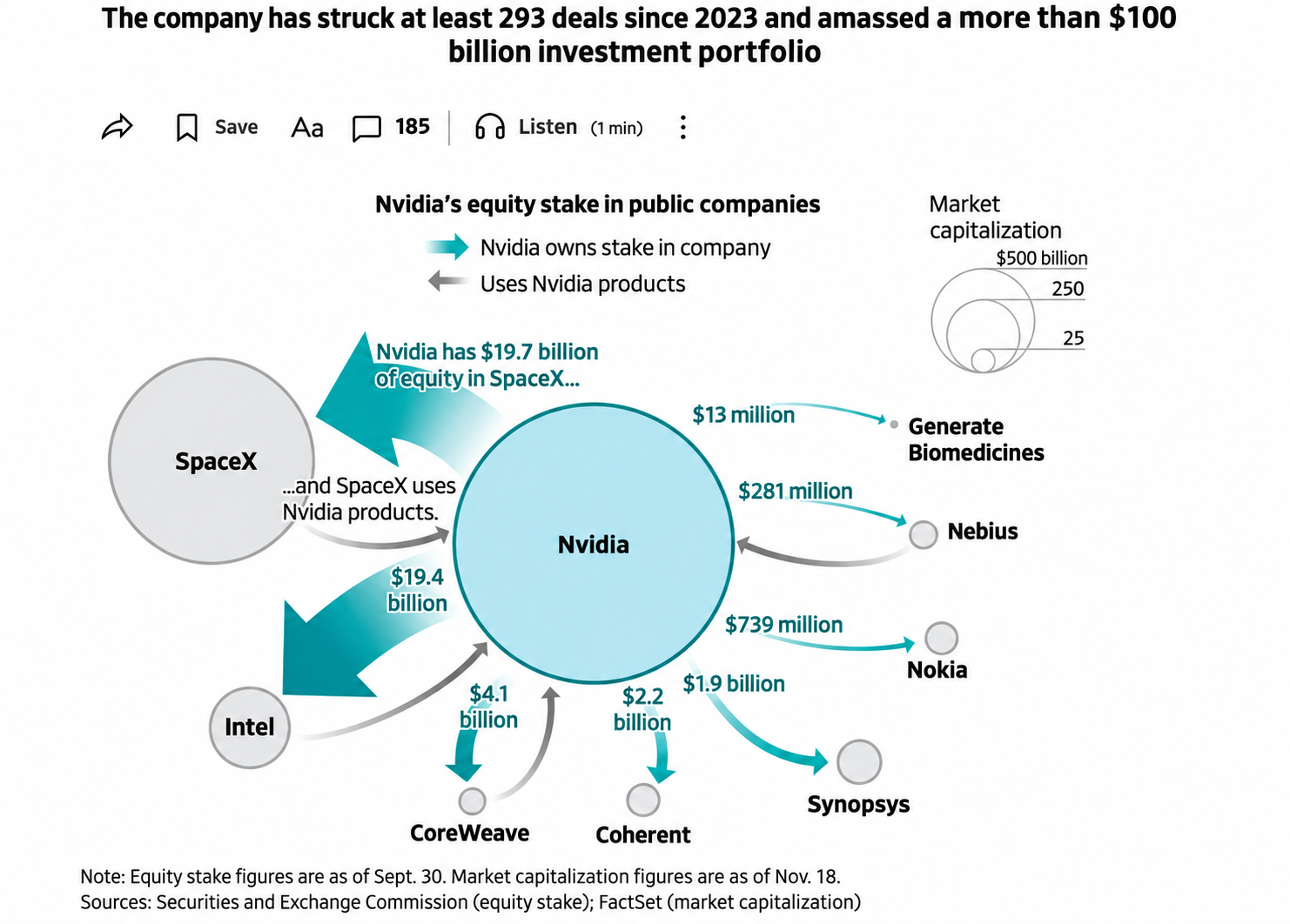
An illustration of Nvidia’s extensive investments in major technology companies highlights its central role in financing the artificial intelligence industry and the potential economic consequences of uncertainty surrounding its leadership.
Business Relationships and Workplace Accountability
Diana Ding, founder and CEO of Ding Ding TV, joined the briefing from China, where she had been observing public reaction to Huang’s departure. She described widespread disappointment among people who admired his accomplishments, while emphasizing that professional success does not exempt executives from personal accountability. Ding also warned that heightened geopolitical tensions could discourage immigrant entrepreneurs from maintaining legitimate international business relationships. Professionals operating between California, Taiwan and mainland China may increasingly fear that ordinary commercial contacts could generate questions about their loyalty. She emphasized the importance of consistent regulations governing sensitive technology, including information sharing and semiconductor exports. Addressing Huang’s reported relationships with company employees, Ding stressed the responsibilities that come with executive authority. Senior executives influence promotions, employment opportunities, and workplace culture, making professional boundaries particularly important. “I believe the CEO should take responsibility to keep the professional boundaries,” Ding said, arguing that women in technology must be able to advance professionally and report concerns without fear of retaliation. Her observations underscored the importance of holding corporate leaders accountable without allowing individual misconduct to become justification for broader discrimination against immigrant professionals.
The Economic Stakes for America
Beyond the controversy surrounding Huang, Cummings warned that Nvidia’s leadership crisis could expose financial vulnerabilities throughout the artificial intelligence industry. He explained that Nvidia is not merely a semiconductor supplier. Through investments, credit arrangements, and financial commitments, it has become an important source of financing for companies developing AI infrastructure. Cummings estimated that approximately $1.2 trillion had been invested in AI infrastructure between 2024 and 2026, with Nvidia playing a central role in supporting the industry’s expansion. He warned that a successor could reconsider Huang’s aggressive financing strategy, potentially reducing the capital available to companies building data centers and purchasing advanced chips. Such changes could have consequences beyond technology stocks, affecting investment, employment, suppliers, and businesses increasingly dependent on AI development. For immigrant communities in Houston, Dallas-Fort Worth and across America, the implications are substantial. Many immigrants work in engineering, research, technology, healthcare, and businesses connected to these expanding industries. Economic instability could affect their employment opportunities, while heightened national security concerns could create additional barriers to advancement. The Nvidia crisis therefore presents America with two simultaneous challenges: safeguarding sensitive technologies and preserving an economy strengthened by international talent. As investigations continue and Nvidia searches for new leadership, the central question is whether the country can maintain legitimate national security protections without allowing suspicion, stereotyping, and discrimination to undermine the immigrant contributions that helped establish its technological leadership