

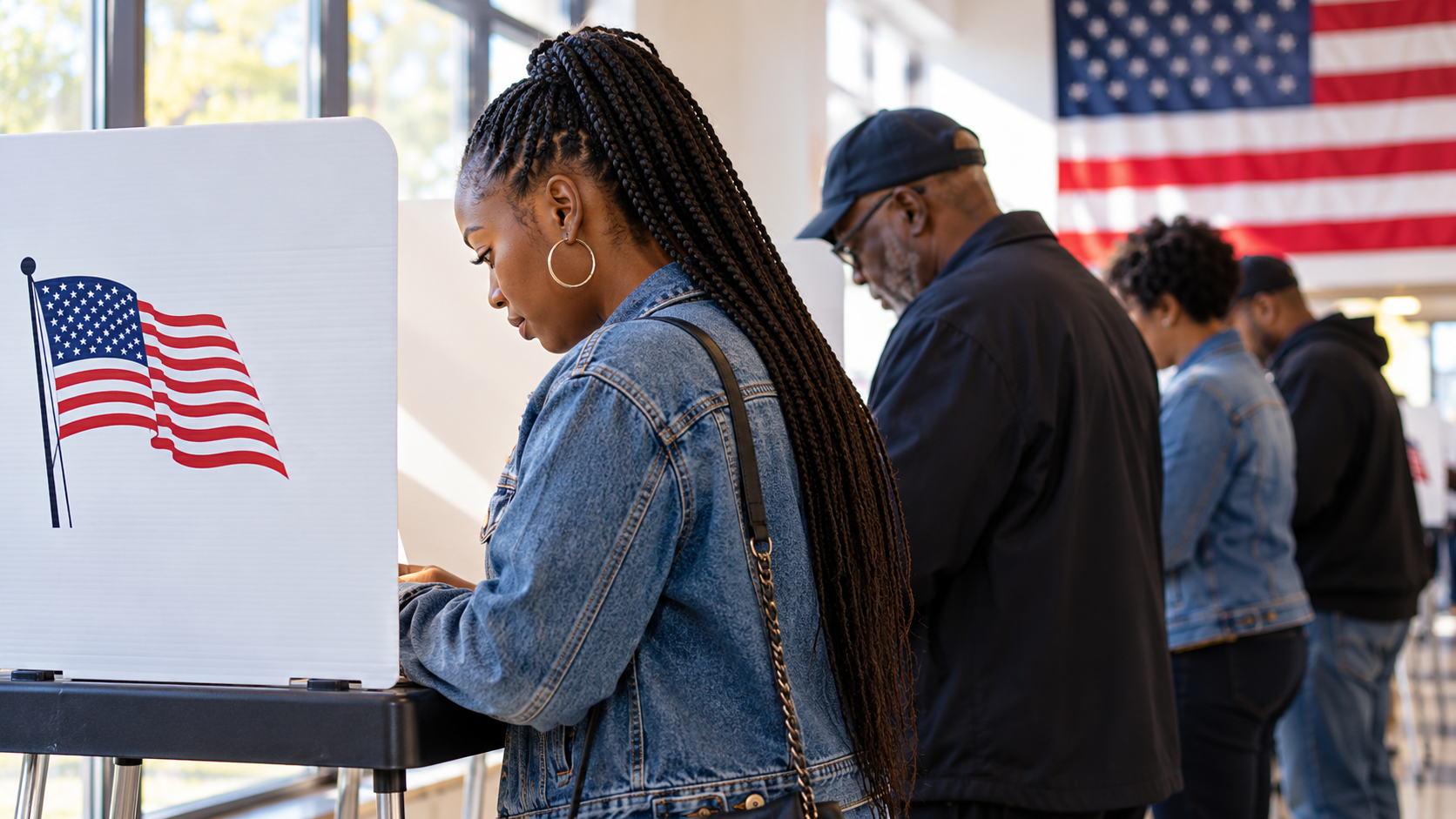
Black Americans remain among the Democratic Party’s most reliable voters, but their political loyalty may not be enough to guarantee electoral victories in the November 3 midterm elections. Growing economic pressures, dissatisfaction with political leadership, shifting congressional boundaries, and concerns about voting rights are creating a complicated environment where turnout could matter more than party preference. For millions of Black voters, the central question is no longer which political party deserves their support, but whether voting will meaningfully improve their lives.
That concern emerged from an October 2 national news briefing organized by American Community Media (ACOM), titled Profiling America’s Changing Electorate: The Black Vote in 2026, Turnout, Resistance and the Fight for Representation. Moderated by ACOM Associate Editor Pilar Marrero, the discussion brought together Emory University political scientist Dr. Andra Gillespie, Black Men Vote Executive Director Michael Bland, and voting rights advocate Evan Milligan. Their assessments highlighted a common challenge facing political campaigns: winning Black votes and ensuring that Black voters actually participate are two different objectives.
Economic Pressures and Voter Enthusiasm
Research cited during the briefing suggested that Black voters recognize the importance of the coming election but are not necessarily committed to participating. According to figures Marrero presented from Black Men Vote research, 92 percent of surveyed young Black men considered voting important. In comparison, 26 percent remained uncertain or unlikely to vote in the midterms. Separate research she attributed to the Black Ops Project found that 64 percent of respondents said attacks on voting rights and Southern gerrymandering made them more likely to vote.
Dr. Gillespie, associate professor of political science and director of the James Weldon Johnson Institute for the Study of Race and Difference at Emory University, cautioned against interpreting recent Republican gains among Black voters as evidence of a lasting political realignment. She explained that Black Americans still overwhelmingly support Democratic candidates, although their participation in midterm elections has historically been lower than in presidential contests. She also warned that some national polls rely on relatively small samples of Black respondents, limiting the precision of conclusions drawn from their findings.
For Gillespie, affordability, employment and inflation remain especially important concerns. Although voting rights and racial justice can motivate participation, everyday economic pressures may influence individual decisions more. She emphasized that Black voters cannot be understood through a single political issue or demographic stereotype. Their priorities overlap with those of other Americans, even as racial inequalities and longstanding barriers to political participation create additional concerns.
Michael Bland, executive director of Black Men Vote and a veteran political organizer, offered a sharper criticism of political outreach to Black men. He argued that campaigns often misunderstand this constituency’s priorities, focusing on familiar political messages while overlooking entrepreneurship, education, employment, mental health, and family responsibilities. According to Bland, Black men are too often discussed as a political problem rather than approached as voters whose economic aspirations deserve serious attention.
Bland also challenged claims that Black men have abandoned the Democratic Party, pointing to their substantial support for Kamala Harris in the 2024 presidential election. He maintained that political organizations must invest in meaningful relationships throughout the year instead of appearing only during election season. He argued that career development opportunities, community conversations, and engagement through trusted local leaders could prove more effective than celebrity endorsements or last-minute campaign appeals.
Voting Rights and Representation Under Pressure
Beyond political enthusiasm, another question remains: can Black communities translate votes into representation? Evan Milligan, the lead plaintiff in the landmark Supreme Court case Allen v. Milligan, warned that developments in voting rights litigation have created new challenges for communities seeking fair congressional representation.
Milligan described how the Voting Rights Act of 1965 expanded Black political participation across the South and how later court decisions weakened key federal protections. The Supreme Court’s 2013 ruling in Shelby County v. Holder effectively ended the Act’s preclearance system, under which certain jurisdictions had to obtain federal approval before changing voting rules. Subsequent litigation increasingly centered on Section 2, which allows challenges to discriminatory voting practices.
His own Alabama case produced a significant Supreme Court victory in 2023, requiring a congressional map that offered Black voters a fairer opportunity to elect a preferred candidate. However, Milligan expressed serious concern about the Court’s April 2026 decision in Louisiana v. Callais, which changed the legal framework governing race-conscious redistricting.
Gillespie similarly warned that changes to congressional maps could affect Black representation differently across states. Even when voter enthusiasm rises, district boundaries may limit how much increased turnout translates into electoral gains. Milligan emphasized that civic organizations, cultural institutions, and faith communities must maintain long-term voter education efforts rather than measuring their effectiveness through one election.
Black Immigrants and the Stakes for Texas
The discussion also raised questions about Black immigrants, particularly those facing concerns over immigration enforcement and political representation. Bland reported that conversations within his organization’s focus groups suggested growing awareness that immigration policies affecting Haitian and other immigrant communities could have broader consequences. Gillespie acknowledged that the available polling data were insufficient to draw reliable conclusions specifically about Black immigrant voting attitudes.
These questions have particular relevance for Houston, Dallas-Fort Worth and other Texas communities where Black Americans, African immigrants and their families participate in civic and community life. For eligible voters, understanding registration requirements, congressional representation and candidates’ positions on economic and immigration policies remains essential.
Texas voters face a November 3 election, with early in-person voting scheduled from October 19 through October 30. The state’s October 5 voter registration deadline has already passed, making it especially important to verify existing registration status.
Ultimately, the briefing presented the Black electorate not as a predictable voting bloc, but as a diverse population confronting competing economic, legal and political pressures. Whether those concerns generate greater participation will help determine the outcome of congressional contests and the future of political representation. The speakers suggested the longer-term test will be whether elected officials and political organizations continue engaging Black communities after the ballots are counted.