


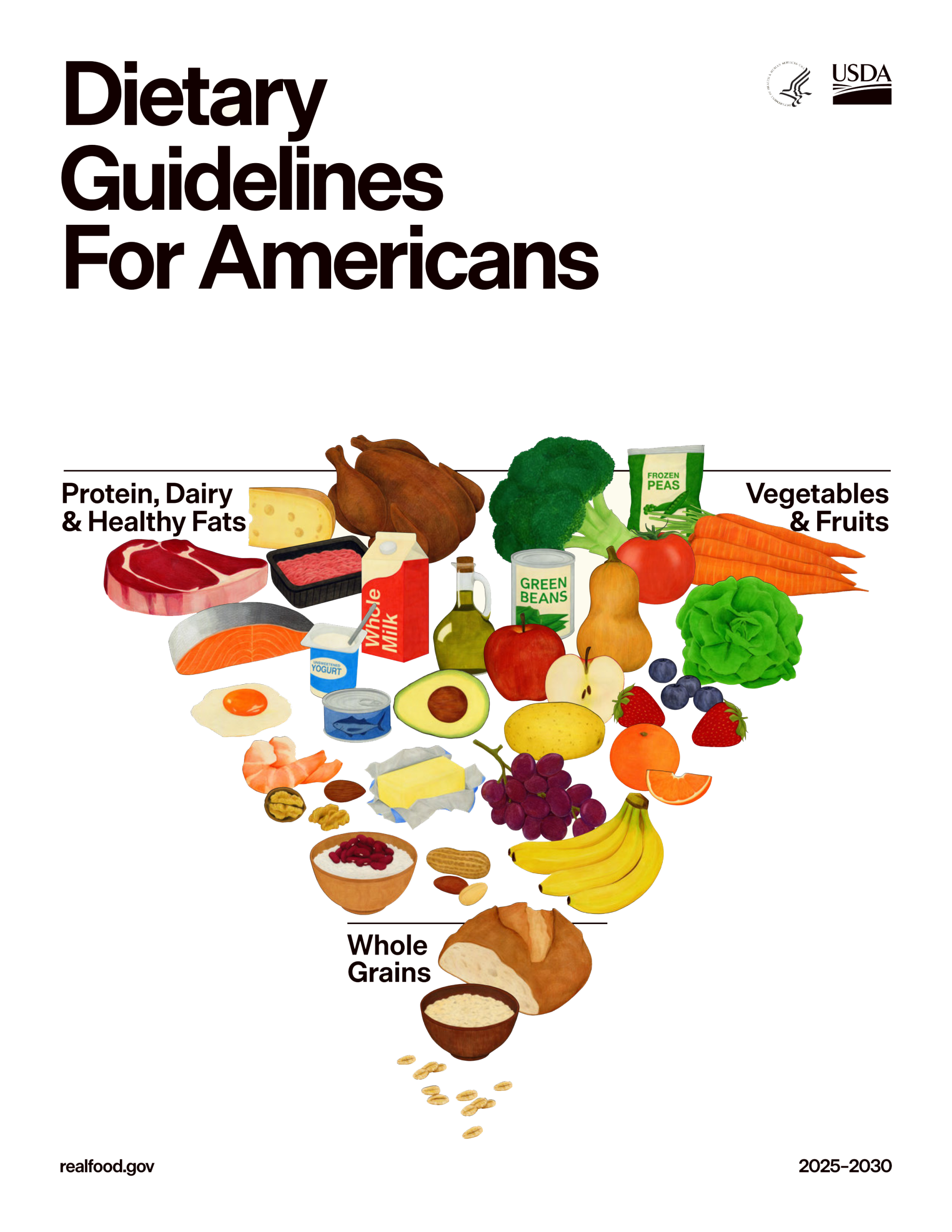
When the federal government unveiled a new food pyramid in January as part of the 2025 to 2030 Dietary Guidelines for Americans, it immediately stirred debate among nutrition experts, public health advocates, and environmental voices. At a recent American Community Media news briefing, panelists warned that the new guidance may create confusion for families, schools, and communities already struggling to make healthy food choices.
Moderator Sunita Sohrabji opened the session by explaining that the updated pyramid reverses the traditional structure Americans have known for decades. Instead of placing grains at the base, the new model prioritizes protein, full-fat dairy, healthy fats, fruits, and vegetables, while moving whole grains to the bottom. It also discourages refined carbohydrates, added sugars, and highly processed foods, but nearly doubles the earlier recommended protein levels.
Confusion Over a Reversed Pyramid
Dr. Christopher Gardner, professor of medicine at Stanford University School of Medicine, said the shift is not as revolutionary as it appears. In fact, he argued that much of the text still contains sound nutrition advice, but the visual message is confusing and overly dramatic.
“I actually take the flipping of the pyramid as being a sensationalist approach to say this is so radical that we have flipped the whole pyramid upside down,” Gardner said.
He noted that earlier food guidance had shifted from the pyramid to the MyPlate model during the Obama administration because it was easier for the public to understand. Bringing the pyramid back, especially in inverted form, raises questions about what Americans are actually being told to eat more of and less of.
Gardner said one of his biggest concerns is the heavy emphasis on protein. “Protein has never been a nutrient of concern,” he said, warning that the message may reinforce a growing market for protein-enhanced products that are more about marketing than nutrition.
He also criticized the visual prominence given to meat and butter, especially after dietary experts had recommended more legumes and less red and processed meat. “It was a bit of a slap in the face,” he said.
School Lunches and Family Realities
Gardner stressed that one place where federal dietary guidance truly matters is school lunch. Because school meal programs are tied to federal standards, changes in the guidelines can directly shape what children eat every day.
He praised the stronger language against sugar and ultra-processed foods, but questioned how schools are supposed to improve meals without more support. “They’ve always been handcuffed by not having enough funding to provide healthy foods for school,” he said.
When asked whether parents should send food from home instead, Gardner said the issue is more complicated than it seems. Many parents do not have the time, money, transportation, or kitchen resources to prepare healthy lunches regularly. He also noted that some packed lunches can be just as unhealthy as cafeteria meals.
On the broader message of the new guidance, Gardner offered one simple point of agreement. “I really like the push for eating real food,” he said.
Personal Responsibility Versus System Change
Dr. Marion Nestle, professor emerita of nutrition, food studies, and public health at New York University, argued that the new guidelines place too much responsibility on individuals while letting government and industry avoid deeper reforms.
“If the focus is on personal responsibility, then the government’s role is in fact education,” she said. “The food industry loves that because the food industry knows perfectly well that education is not enough to change dietary behavior.”
Nestle said the new pyramid is clearly “meat-centric” and implicitly signals that people should eat more meat and more high-fat dairy. She also criticized the assumption that everyone can simply choose healthier foods if they want to.
“If you, as an individual, are going to a grocery store to try to eat healthfully, you are fighting the entire food system on your own,” she said.
Nestle explained that many low-income families face barriers that go far beyond food prices. Some lack nearby grocery stores, transportation, cooking equipment, refrigeration, or time to prepare meals after working multiple jobs. In those circumstances, she said, ultra-processed foods fill the gap because they are cheap, convenient, and heavily marketed.
She also pushed back against the protein craze. “In the United States, protein is a non-issue,” she said. “The fact that protein is being added to everything is a matter of marketing. It has nothing to do with science.”
Environmental Warnings
Dr. Sailesh Rao, founder of Climate Healers, took the conversation in a different direction by focusing on the environmental costs of a diet that leans more heavily on meat and dairy. He argued that the guidelines ignore the ecological consequences of food production and called for a larger transformation of the food system.
“The purpose of the food system should be to nourish people,” Rao said. “Today, the purpose of the food system is not to nourish people, it’s to make money for someone.”
He contrasted what he called Planet A, a system driven by extraction and profit, with Planet B, a system built around regeneration, public health, and sustainability. He argued that schools and families could benefit from culturally grounded plant-based meals that are affordable, nutritious, and environmentally responsible.
A Debate Far From Over
Taken together, the briefing made clear that the new food pyramid is about much more than nutrition charts. It touches on questions of politics, poverty, public health, cultural tradition, education, and environmental stewardship. While some experts welcomed the tougher talk about sugar and ultra-processed foods, they also warned that without deeper structural reforms, the new pyramid may create more confusion than clarity.