

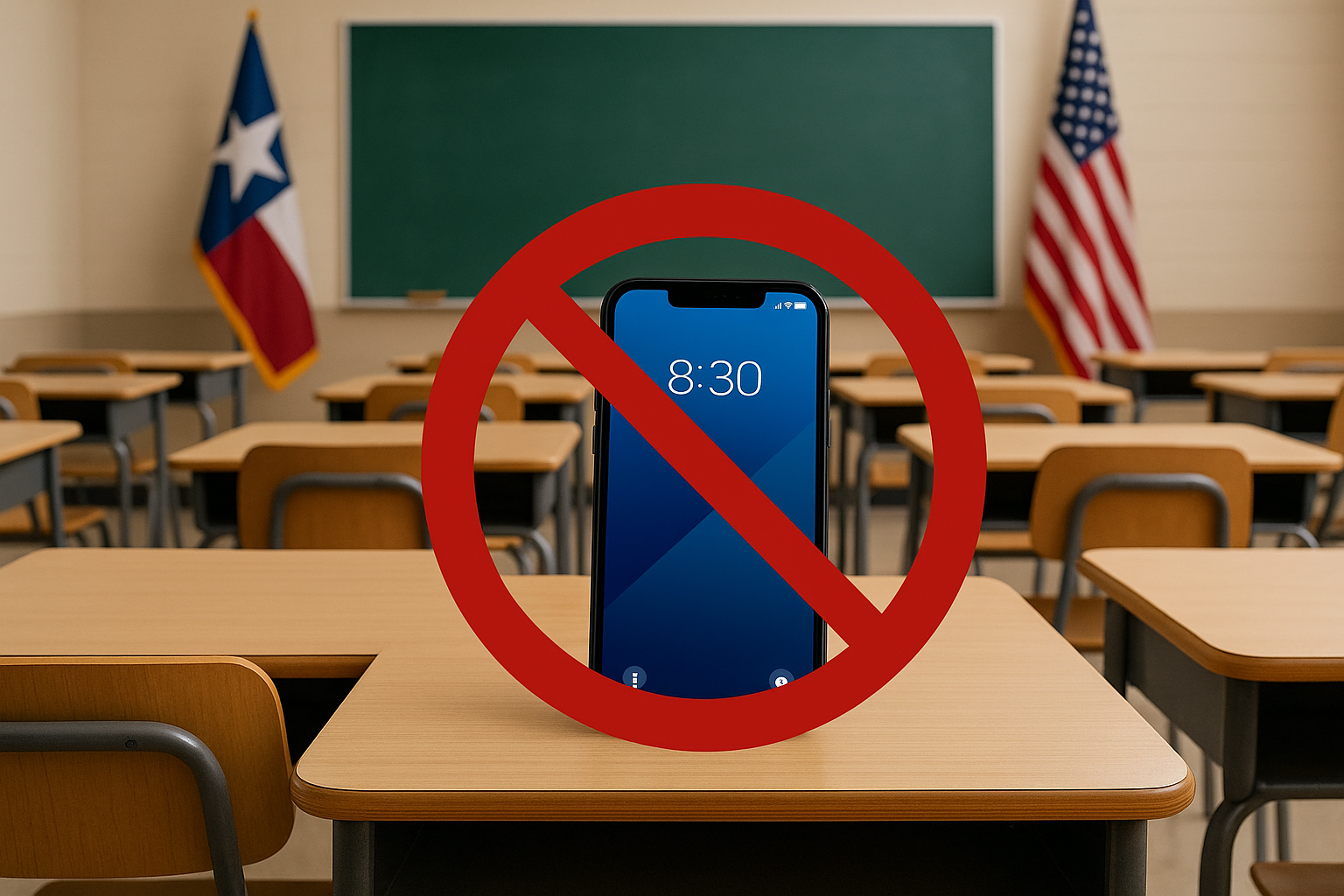
As students across Texas prepare their backpacks for the start of a new school year, there’s one item many will be leaving at home or locking away once they arrive on campus: their cellphones.
Under a sweeping new law—House Bill 1481, passed by the Texas Legislature earlier this year—students are now prohibited from using personal communication devices during the school day, with few exceptions. The law has sparked debate among educators, parents, and students alike, ushering in a new era of digital discipline in the classroom.
A Statewide Policy With Local Implementation
House Bill 1481, which took effect on June 20, 2025, requires all public school districts in Texas to establish and enforce a policy restricting the use of personal communication devices by students during instructional hours. Districts have until September 18 to implement their policies.
The law defines “personal communication devices” as cellphones, smartwatches, tablets, or any non-school-issued device capable of sending or receiving electronic messages or accessing the internet. Each school district can choose how to implement the rule—some have opted for complete bans, while others allow students to bring devices but require them to be stored and powered off during the school day.
At its core, the law aims to reduce distractions, improve focus, and support student well-being in an increasingly connected—and, at times, digitally overwhelming—world.
Houston and Friendswood Set the Pace
Major districts in the Houston area were among the first to roll out their cellphone bans ahead of the first day of school.
The Houston Independent School District (HISD)—the largest school district in Texas—announced strict enforcement: students are not allowed to use or access their devices at any time during the school day, including lunch and passing periods. Violations will result in confiscation, and repeat offenses may require a parent to retrieve the device or pay a fee.
Nearby Friendswood ISD went a step further by adopting the “Yondr pouch” system, which physically locks students’ phones inside magnetic pouches that remain in the students’ possession but cannot be opened until the end of the day. The system has been used in some private schools and entertainment venues, but is now becoming part of the public school routine.
“We wanted to support student learning and engagement in a world full of distractions,” said a Friendswood ISD official. “Removing easy access to cellphones helps create a space where students can stay focused and interact more meaningfully with peers and teachers.”
West Texas Districts Follow Suit
In West Texas, both Midland ISD and Ector County ISD are implementing versions of the new law, effective September 1.
Midland ISD is banning students from bringing personal devices onto campus, unless there are exceptional circumstances. Ector County ISD allows students to get their phones but requires them to store the devices turned off—either in their backpacks or lockers. Notably, the district does not provide storage solutions, placing the burden on students and their parents.
Some educators in the area have welcomed the change. “We’ve been asking for this kind of policy for years,” said a high school teacher in Midland. “Phones are a huge distraction and a disciplinary issue. This gives us clearer boundaries.”
Leander ISD: A Case Study in Balanced Enforcement
North of Austin, Leander ISD has introduced a graduated response policy. Students are warned on the first offense, have their device confiscated and returned at the end of the day on the second offense, and may require a parent to pick up the phone; failure to do so may result in additional consequences on subsequent violations.
The district has also provided clear guidelines: students must keep devices stored and powered off during the school day, with no usage allowed during passing periods, bathroom breaks, or lunch.
Leander ISD student Peyton Kosh, a senior, expressed mixed feelings: “It’s our senior year, and suddenly we can’t even check the time on our Apple Watches. I get that they want us focused, but it’s a big change all at once.”
Middle school student Adam Vang offered a simpler take: “I didn’t use my phone during school anyway. I don’t think it’ll be that different.”
What the Law Says—and Doesn’t Say
According to guidance issued by the Texas Education Agency (TEA), schools may provide exceptions to the ban in limited cases:
- Students with Individualized Education Programs (IEPs) or 504 plans that require digital tools,
- Medical needs, such as blood sugar monitors that sync with phones or smartwatches,
- Emergency protocols or safety drills where communication is essential.
However, for most students, the law is clear: no texting, scrolling, snapping, or streaming from bell to bell.
Importantly, the law does not apply to school-issued devices, allowing students to continue using district-provided laptops or tablets for instructional purposes.
The Arguments Behind the Ban
Supporters of the new law argue that cellphone restrictions are long overdue. For years, teachers have battled constant digital distractions, and many claim that the learning environment has suffered as a result.
“Phones are like a second appendage for some of these kids,” said a teacher in Leander ISD. “Even during group work or silent reading, they’d be checking messages or watching videos under the desk. You spend half your energy managing behavior instead of teaching.”
The law’s sponsors in the Texas Legislature cited academic research linking excessive cellphone use to declining educational performance, social isolation, and mental health concerns—especially among teenagers.
National surveys show a majority of Americans support school cellphone bans. A 2024 Pew study found that 68% of parents favor restricting phones in classrooms, and 71% of teachers said phones have a negative impact on learning.
Pushback and Concerns from Parents and Students
Not everyone supports the ban. Some parents worry about being unable to contact their children in the event of an emergency, especially in light of recent school safety concerns in Texas and across the country.
Crystal Castillo, a parent in Houston, said she understands the intent behind the policy but still has reservations. “My daughter has anxiety, and sometimes texting me helps calm her down between classes. I trust her to be responsible. This one-size-fits-all rule punishes the kids who weren’t the problem.”
Others have pointed out that banning phones doesn’t automatically eliminate distractions. “Kids will still find ways to zone out,” said Tripp, a high school junior in Friendswood. “What if I want to listen to music at lunch or read a book on my phone? We’re being treated like we can’t make any decisions.”
Some educators share these concerns, particularly about enforcement. “What happens when a student refuses to hand over a phone?” asked one principal anonymously. “We don’t want to create power struggles or escalate situations over something that could be handled more gently.”
Early Results: More Conversation, Less Scrolling
Despite the controversy, some districts have already seen noticeable changes.
A Leander ISD teacher posted anonymously on Reddit:
“It’s only been a few days, but lunch was louder—because the kids were talking to each other. The dining hall used to be almost silent, with everyone glued to their screens. Now it feels like a real community again.”
Teachers also report that students are more engaged in class discussions, complete assignments more quickly, and rely less on digital crutches for entertainment.
Looking Ahead
As Texas schools continue to adapt to the new policy, educators and families will closely monitor its impact on behavior, academic outcomes, and overall student well-being.
There are likely to be adjustments along the way—especially as districts learn what works and what doesn’t. Some may invest in lockable pouches; others may provide grace periods or offer phone-free zones rather than complete bans.
But one thing is sure: this school year marks a significant cultural shift in how Texas approaches technology in education.
Whether the cellphone ban becomes a model for other states—or a cautionary tale—will depend on how schools implement it, how students respond, and how well the law balances discipline with flexibility in an increasingly connected world.